Kubernetes Bottleneck is Broken, Development Taxes Are Repealed: Announcing HariKube 1.0

Table of Contents
For too long, the “Kubernetes Tax” has been a mandatory payment for every engineering team. You pay it in time spent configuring YAML, you pay it in cognitive load trying to understand networking, and you pay it in performance when etcd hits its scaling limit.
Today, we are announcing a tax-free future. HariKube 1.0 is officially here.
🏋️ The End of the Etcd Bottleneck
Standard Kubernetes relies on etcd - a marvelous piece of tech that, unfortunately, wasn’t built for the sheer volume of data modern enterprises throw at it. When you scale, etcd slows. When etcd slows, your entire platform crawls.
HariKube breaks this cycle. By introducing a database-agnostic middleware, we’ve decoupled the Kubernetes API from its legacy storage. You can now power your cluster with multiple backends - including PostgreSQL, MySQL, TiDB, YugabyteDB, CockroachDB, and HariKube itself (matrix of multi-dimensional databases).
The result? 10x to 50x more operations per second. Your control plane finally has the horsepower to match your ambitions, and finaly it became the Single-Source-of-Truth not just for your infrastructure, but your custom services as well.
| Metric | HariKube 6xPostgres | Vanilla K8s | Gain |
|---|---|---|---|
| Objects Handled | 200k+ ✅ | ~26k ❌ | 8× |
| Throughput | 119 req/s ✅ | 25 req/s ❌ | 4.8× |
| Success Rate | 100% ✅ | OOM 💀 | ♾️ |
| Latency average | 167ms ✅ | 799ms ❌ | 4.8× |
| Latency p95 | 543ms ✅ | 2820ms ❌ | 5.2× |
| Latency p90 | 398ms ✅ | 2470ms ❌ | 6.2× |
| Test Duration | 60m ✅ | ~34m ❌ | ~2x |
| Stability | Completed ✅ | OOM 💀 | ♾️ |
While HariKube’s performance is crucial, maintaining a low overall error rate is equally important to ensure reliability and user trust. Vanilla K8s reached Halt and Catch 🔥. Kubernetes API server has been 💀 OOM Killed on the same setup.
🏗️ Repealing the “Development Tax”
Platform engineering shouldn’t feel like a second job for your developers. The “Development Tax” is the hours lost to boilerplate and infrastructure debugging. Kubernetes based on HariKube acts as a true Platform-as-a-Service (PaaS), abstracting the complexity so your team can get back to writing features. HariKube offers a Language-Agnostic Unified Service Model design pattern, where services - serverless functions, operators, traditional REST APIs - become First-Class Citizens in the cluster by using standard Cloud-Native tools only.
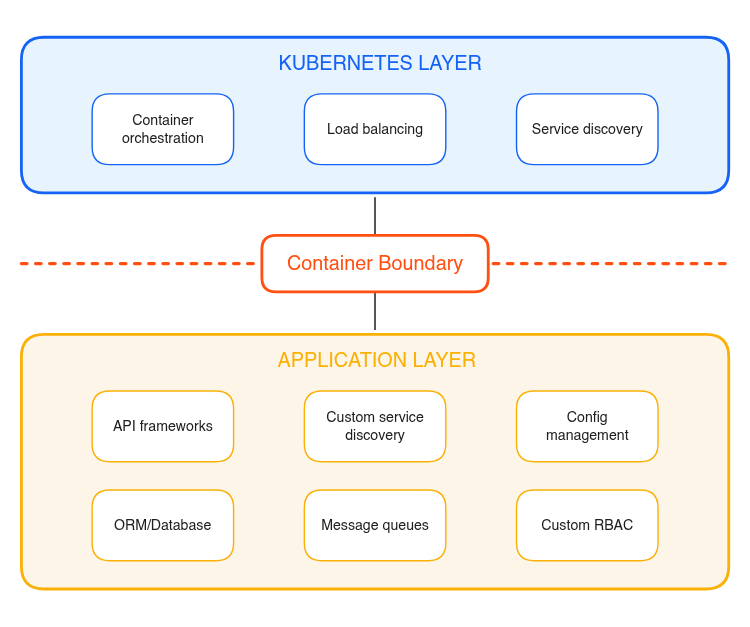
Legacy vs. Unified Service Model
The Container Boundary
- Applications are silos on top of Kubernetes
- Bring Your Own Foundations
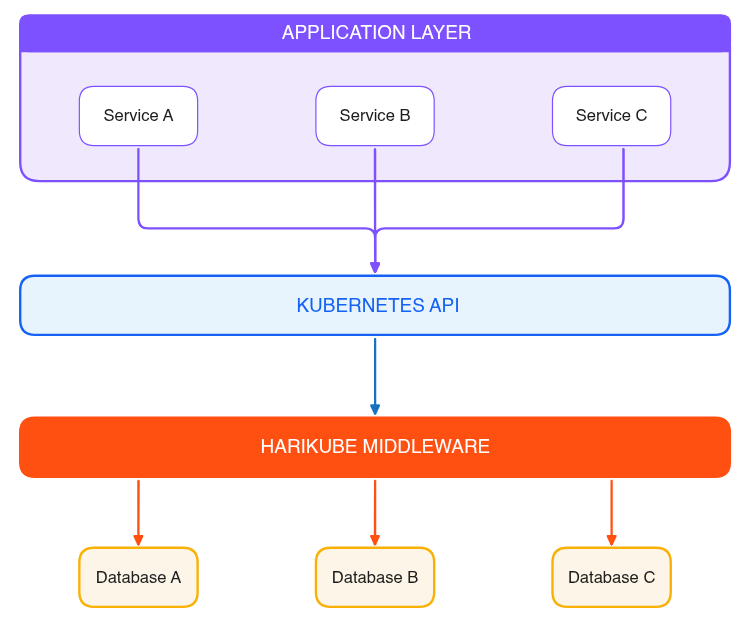
First Class Citizens
- Applications are part of Kubernetes
- Rely on Cloud-Native Foundations
Research consistently demonstrates that software engineers spend approximately 50% of their time on “glue code” and infrastructure integration rather than core business logic. Forget replication of boilerplate in each project, rely on Kubernetes built-in features instead.
🏁 Achieve Both: Performance and Rapid Development
HariKube is not a choice between a faster developer experience and technical performance - it delivers comprehensive benefits by addressing both core limitations of standard Kubernetes.
🎯 Who is HariKube For?
We didn’t build HariKube for everyone. We built it for the outliers - those who have pushed Kubernetes to its breaking point and felt it push back. If you recognize your own struggles in the scenarios below, HariKube was built specifically for you.
- The Scaling Enterprise: You’ve hit the “etcd wall.” Your clusters are bloated with CRDs, API latency is spiking, and your growth is hitting a ceiling. You need the horizontal scale of distributed SQL to keep your business moving at the speed of your ambitions.
- The Platform Architect: You’re tired of the “abstraction tax.” You want to deliver a seamless, Heroku-like developer experience without stripping away the raw power of the Kubernetes ecosystem or inventing proprietary DSLs that your team has to unlearn later.
- The Visionary Dreamer: You aren’t planning for the next sprint; you’re architecting for the next decade. You need a foundation that transcends the limitations of legacy orchestration - a system that adapts to your imagination rather than forcing your vision into a pre-defined box.
- The Future-Proof Architect: You’ve seen “next-gen” tools come and go. You’re done reinventing the wheel every two years. You demand industrial-grade, standards-based tooling that doesn’t just patch today’s bottleneck but evolves alongside the industry.
- The Sovereign Strategist: You’ve been burned by “black box” ecosystems and proprietary traps before. You refuse to let your infrastructure become a golden cage. You need a platform that is totally transparent - one that runs on any Kubernetes and uses standard cloud-native services. With HariKube, you keep your autonomy; your services remain portable, your stack remains standard, and your exit strategy is built-in by design.
- The Velocity-Focused Delivery Manager: You know that “shifting left” shouldn’t feel like slamming on the brakes. You’re here to eliminate the “Kubernetes Tax,” transforming your infrastructure from a complex hurdle into a high-speed lane that lets your team ship with total confidence.
- The Economic Strategist: You’re tired of “scaling” meaning “spending.” You’ve watched your cloud bill explode alongside your cluster size, and you know that traditional Kubernetes resource management is a leaky bucket. You need a system built for resource efficiency and predictable overhead, not just raw capacity.
- The Multi-Cloud Nomad:You refuse to be held hostage by a single cloud provider’s managed K8s quirks. You need a consistent, powerful control plane that feels the same whether it’s running on bare metal, AWS, or at the edge. You’re building a sovereign infrastructure that belongs to you, not your vendor.
🚀 The Road to 1.0 and Beyond
Reaching 1.0 is more than just a version bump; it’s a commitment to API stability, production-grade reliability, and a future where infrastructure serves the developer - not the other way around.
By decoupling the storage layer and abstracting the complexity, we aren’t just making Kubernetes faster; we’re turning it to core fundamental of your services.
🤝 Giving Back: The Open Source Foundation
While HariKube 1.0 represents the pinnacle of our enterprise-grade platform, we haven’t forgotten our roots. We are incredibly proud to have shared the core fundamentals of this architecture through our open-source edition.
For teams just starting their journey or those who want to “taste” what Kubernetes-as-a-Platform feels like, our open-source projects offer the same unified concept. While this community version is limited to a single database backend (PostgreSQL, MySQL, SQLite), it provides the perfect entry point for explorers who want to experiment with the Unified Service Model and validate the performance gains of using HariKube-backed Kubernetes on a smaller scale.
Expanding the Ecosystem
Our commitment to the community goes beyond just the core platform. We have released a suite of lightweight tools and frameworks designed to make platform integration seamless.
- The flagship among these is our Serverless Kubernetes Watch Trigger Operator. This lightweight tool transforms Kubernetes API server watch events into direct trigger sources for serverless functions and external systems. It allows you to declaratively define exactly when and how webhooks or functions should fire in response to resource changes - all without the need to modify the API server or manage heavy, complex eventing frameworks.
- We’ve open-sourced the Kubernetes Aggregation Framework that simplifies extending the core Kubernetes API. Think of it as a gateway that lets you add any resource types to your cluster that behave exactly like native objects or Custom Resources, ensuring your bespoke tools feel like a natural part of the ecosystem.
- Last but certainly not least, we’ve shared a set of critical changes designed to achieve storage-side filtering within Kubernetes. By pushing data filtering logic down to the storage layer, we significantly reduce the amount of unnecessary data transferred over the network, drastically improving performance for data-intensive applications.
We believe the “tax-free” future should be accessible to everyone - from the lone developer to the global corporation.
🦸 Ready to Build The Next Gen?
Whether you are scaling a global enterprise or building the next disruptive startup, you shouldn’t have to choose between performance and developer happiness. With HariKube 1.0, you get both.
- Read the full documentation
- Learn more about Unified Service Model
- Dirty your hand and jump into the middle
- Explore features:
- Download the whitepaper
- Discover future plans
The bottleneck is broken. The taxes are repealed. It’s time to ship.
That’s it! The bottleneck is gone and the taxes are repealed. If you’re ready to make the mental shift to a hyperscale, unified service model, contact with us.
Thank you for reading, and feel free to share your thoughts.